

Lewis County: Trash and Recycling

Lewis County faced three major challenges:
Disconnected data systems – Tonnage data in Compu-Weigh's Paradigm server, financial data in Tyler Munis ERP, and operational records in Excel spreadsheets with limited integration between them
No strategic visibility – Leadership couldn't easily correlate spending with waste volumes to make informed decisions on tip fees, vehicle maintenance, or staffing capacity
Comprehensive but siloed data – The department tracked critical metrics like diversion rates and tonnage, but the data couldn't quickly answer strategic questions or easily tell a coherent story
Rather than accept these limitations, county leaders took action by partnering with Quantify Consulting.
The Problem
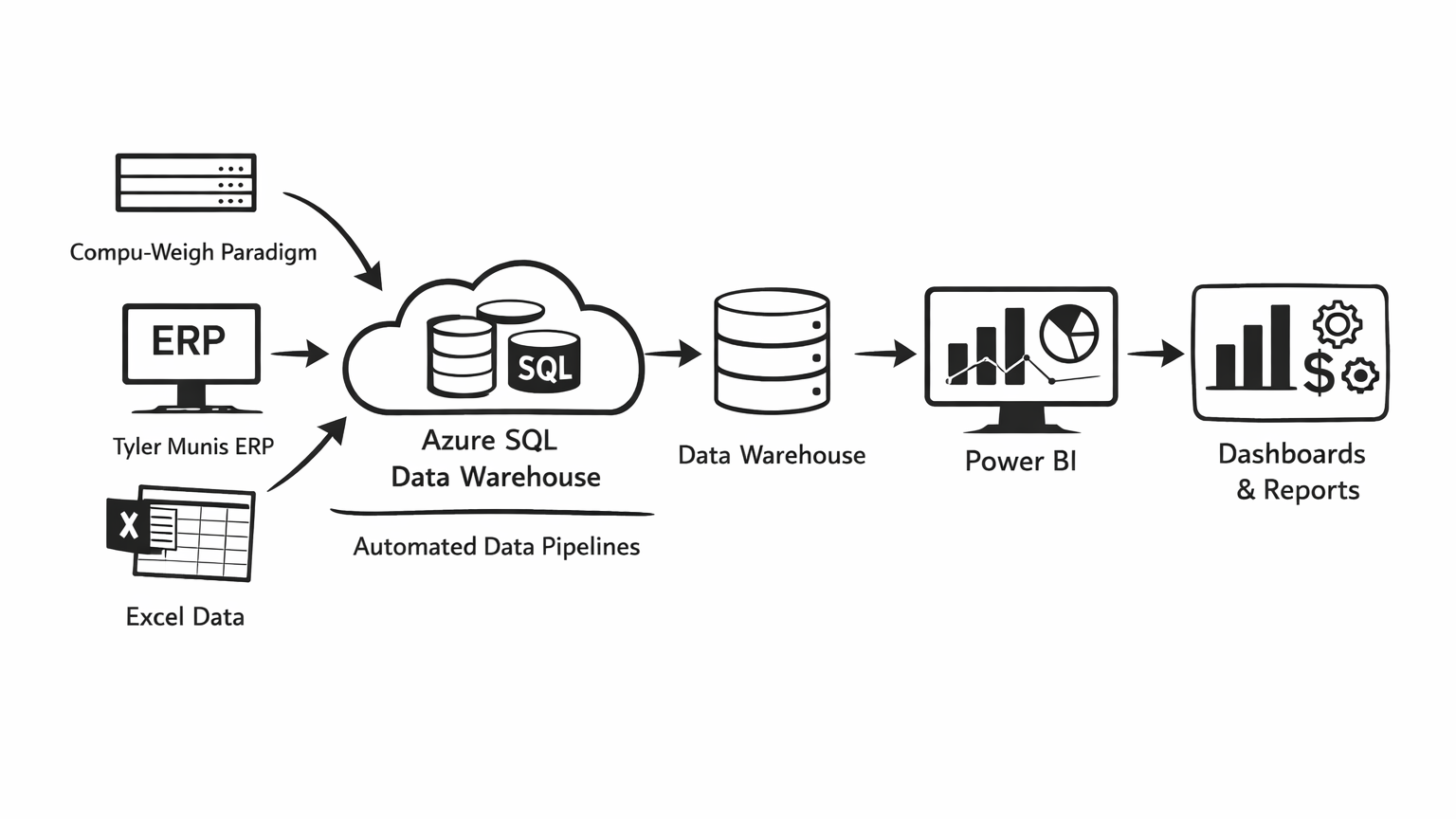
The Solution: Connected Data Sources
We connected the Compu-Weigh Paradigm server, Tyler Munis ERP, and Excel-tracked operational data into the existing Azure SQL data warehouse, creating automated pipelines that unify financial and operational metrics.
Raw tonnage data, budget line items, and operational records were cleaned, standardized, and organized around strategic KPIs that leadership actually uses for decision-making.
The Solution: Visual Storytelling
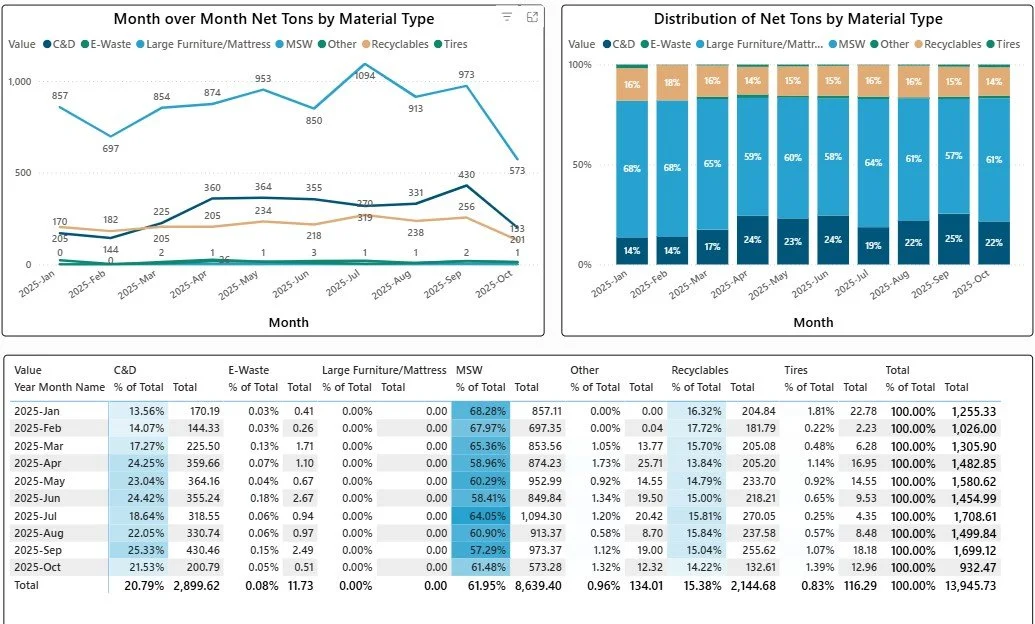
Quantify Consulting integrated the Compu-Weigh Paradigm server, Tyler Munis ERP, and Excel operational data into the county's existing Azure data warehouse, then built two strategic Power BI dashboards:
Public Dashboard – Real-time waste diversion rates and recycling volumes demonstrating environmental stewardship to citizens
Internal Dashboard – Public metrics plus financial cost analysis, cross-station comparisons, and detailed expense tracking
We re-architected the infrastructure around strategic KPIs: diversion rate tracking, progress against the 3,000-ton OHSWA threshold, and cost-per-ton analysis—transforming raw data into actionable operational intelligence.
The Impact
Leadership now correlates spending with waste volumes to make data-driven decisions on tip fees, vehicle replacement, and staffing. Real-time performance metrics across both transfer stations reveal efficiency opportunities instantly, all while offering transparency to the public.
By connecting existing systems—Compu-Weigh scales, Tyler ERP, and Excel spreadsheets—rather than replacing them, we delivered strategic operational intelligence without a large scale tech stack overhaul.
The result: strategic decisions based on integrated data, public transparency, and optimized operations across two transfer stations.